In today’s competitive marketplace, a trademark is more than just a legal right—it’s a brand’s identity and personality. It not only helps consumers recognize and differentiate products or services but also acts as a powerful marketing tool that creates loyalty and trust. The visual or linguistic mark by which a business is remembered often becomes inseparable from its reputation.
Under Indian trademark law, not every name, word, symbol, or phrase is eligible for registration. The Trade Marks Act, 1999 lays down both absolute and relative grounds for refusing a trademark application. While relative grounds focus on conflicts with earlier marks, absolute grounds deal with the inherent nature of the trademark itself.
Among these, one of the most significant hurdles is descriptiveness. However, the law also recognizes a crucial exception—when a descriptive mark has acquired distinctiveness or a secondary meaning.
Understanding the Concepts
Descriptive Marks
These marks directly describe:
A feature or quality (e.g., “Cold and Creamy” for ice cream)
A purpose or function (e.g., “Cleaner” for detergent)
Ingredients (e.g., “Honey Almond” for cereal)
They are generally not inherently distinctive and are barred from registration under Section 9(1)(b) of the Indian Trade Marks Act, 1999.
Distinctiveness / Secondary Meaning
A mark that initially lacks inherent distinctiveness may become distinctive over time through extensive use and recognition by the public. This is known as acquired distinctiveness or secondary meaning.
Examples:
“Best Buy” – originally descriptive, but now distinctive due to widespread recognition.
“Holiday Inn” – once generic/descriptive, now a strong brand.
Legal Framework: Absolute Grounds of Refusal
The absolute grounds for refusal of trademark registration are provided under Section 9 of the Trade Marks Act, 1999. This section aims to prevent the registration of marks that are inherently unfit to function as trademarks.
Section 9
Section 9(1): Lack of Distinctiveness
A mark shall not be registered if:
It is not capable of distinguishing the goods or services of one person from those of another;
It consists exclusively of descriptive elements, i.e., marks that indicate kind, quality, intended purpose, values, geographical origin, etc.;
It consists of terms customary in current language or trade practices.
Section 9(2): Public Interest Considerations
A mark may be refused if it:
Is deceptive or likely to cause confusion;
Contains content offensive to religious sentiments;
Contains scandalous or obscene matter;
Is barred under the Emblems and Names (Prevention of Improper Use) Act, 1950.
Section 9(3): Functional Shapes
A mark may be refused if it consists exclusively of:
The shape of goods resulting from their nature;
A shape necessary to obtain a technical result;
A shape that gives substantial value to the goods.
The absolute grounds for refusal of trademark registration are provided under Section 9 of the Trade Marks Act, 1999. This section aims to prevent the registration of marks that are inherently unfit to function as trademarks.
Descriptiveness vs. Distinctiveness
Descriptiveness vs. Distinctiveness
A descriptive trademark directly conveys information about the characteristics or qualities of the goods or services (e.g., “Crunchy” for chips or “Sweet” for confectionery). Such marks are generally barred from registration under Section 9(1)(b) because they fail to perform the primary function of a trademark—distinguishing the source.
However, the Act provides an important exception
Proviso to Section 9(1): Acquired Distinctiveness
A descriptive or non-distinctive mark can be registered if, before the date of application, it has acquired a distinctive character as a result of its use or is recognized as a well-known trademark.
In essence, even if a mark is inherently weak, it can become strong over time through consistent use, consumer recognition, advertising, and goodwill
Supporting Provision: Section 32
Section 32 offers post-registration protection, stating that if a mark has been wrongly registered in breach of Section 9(1), it shall not be declared invalid if, before the legal challenge, it has acquired distinctive character due to its use
Working Hours
Justfly is a powerful all-in-one camera drone designed for creators on the move. It offers a 1-inch CMOS sensor.
Monday - Wednesday 09:00 AM - 05:00 PM
Thursday - Friday 09:00 AM - 05:00 PM
Saturday - Sunday Closed
Tatiana Dixon
Creative Team
★★★★★
Up maids me an ample stood given. Certainty say suffering his him proposal mistaken collected intention promotion. Hill sold ham men made lose case. Views abode law heard jokes too. Elegance exercise as laughing proposal mistaken if. We up precaution an it solicitude acceptance invitation.
15 Days Ago
Colby Clarke
Sophisticated Design
★★★★★
Maids table how learn drift but purse stand yet set. Music me house could among oh as their. Piqued our sister shy nature almost his wicket. Hand dear so we hour to. He be hastily offence we be hastily offence effects he service. Sympathize it projection ye insipidity celebrated my pianoforte indulgence.
In recent years, Governance, Risk, and Compliance (GRC) have undergone significant changes as businesses acknowledge the importance of strong ethical practices. By 2024, this focus has intensified, driven by global challenges, tighter regulations, and higher expectations from customers and stakeholders. Below are the key trends shaping GRC and ethical business practices this year.
Emphasis on ESG Integration
Environmental, Social, and Governance (ESG) factors have become a central focus in GRC strategies. Companies are integrating sustainability goals into their operations and prioritizing greater transparency in ESG reporting. Globally, regulators are imposing stricter rules for ESG disclosures, prompting businesses to adopt stronger reporting frameworks and maintain high ethical standards.
Core Message: Companies should integrate ESG into their long-term strategies, prioritizing trust-building and value creation over mere compliance.
Applying Technology for Ethical Governance
Innovative technologies like Artificial Intelligence (AI), block chain, and predictive analytics are being more widely adopted to strengthen compliance and ethical practices. AI tools can now identify risks, ensure adherence to regulations, and track unethical behavior in real time.
Core Message: Technology helps drive ethical change by making compliance more proactive and adaptable.
Concentrate on Data Protection and Online Security
With the rise of cyber threats, businesses are focusing more on data privacy and cybersecurity within their GRC strategies. Ethical management of customer data is now crucial, as stricter regulations like GDPR and other laws mandate complete compliance.
Core Message: Earning trust from stakeholders involves more than just adhering to data privacy laws; it also requires a genuine effort to protect user information.
Strengthening Whistleblower Protections
Organizations are updating their whistleblower policies to make it safer for employees to report wrongdoing. Offering better protections and anonymous ways to report is becoming the norm.
Core Message: Allowing employees to voice concerns without the fear of retribution is essential for building a culture of trust and honesty.
Cross-Border Compliance Challenges
As the world becomes more connected, businesses must navigate various rules and regulations across different regions. To address this, companies are developing global compliance programs that are flexible enough to meet local laws and ethical standards.
Core Message: A strong and adaptable GRC strategy can meet both global and local compliance needs, reducing risks and supporting ethical standards.
Leadership with Ethics and Company Culture
Ethical business practices start with effective leadership. In 2024, companies are focusing on training leaders to make ethical decisions and foster a culture of responsibility and honesty throughout the organization.
Core Message: Ethical leadership shapes how an organization behaves, setting the standard for compliance and governance at all levels.
Conclusion: In 2024, ethical business practices are essential for success. Companies that integrate strong GRC frameworks manage risks, meet stakeholder expectations, and build trust. By prioritizing ethics, they strengthen their reputation, adapt to challenges, and foster responsible growth, creating lasting value.
Disclaimer: This blog highlights current trends in GRC for ethical business practices and does not provide legal, financial, or compliance advice. Organizations should consult professionals or legal experts for guidance on specific issues or requirements.
Micro, Small, and Medium Enterprises (MSMEs) are key to a country’s economic growth, boosting jobs, innovation, and industry. In India, the government provides various incentives to support MSMEs. With online registration now available in 2025, it’s easier than ever to register your business as an MSME. Here’s a simple guide to help you through the process and the benefits you can receive from the government.
Step-by-Step Process for MSME Registration Online in 2025
Step 1: Visit the Udyam Registration Portal
Go to the official Udyam Registration website (https://udyamregistration.gov.in/), where businesses can easily register as MSMEs online.
Step 2: Create a New Account
If you don’t already have an account, you’ll need to create one by providing basic details such as your business name, contact number, and email address.
Step 3: Select Your Business Type
You’ll be asked to classify your business as micro, small, or medium based on its annual turnover and investment in machinery or equipment:
Micro: Investment up to ₹1 crore and turnover up to ₹5 crore
Small: Investment up to ₹10 crore and turnover up to ₹50 crore
Medium: Investment up to ₹50 crore and turnover up to ₹250 crore
Step 4: Provide Aadhaar Number
You must enter the Aadhaar number of the business proprietor or authorized signatory for verification purposes.
Step 5: Enter Business Details
Enter your business information, including:
Legal business name
Type of business (Proprietorship, Partnership, LLP, etc.)
Business address and contact information
Bank account details for verification
Step 6: Enter Investment and Turnover Details
Input information about your business’s investment in plant and machinery (for manufacturers) or equipment (for service providers) and annual turnover.
Step 7: Upload Documents
Upload the required documents, including:
Aadhaar number
PAN card
Bank details (e.g., passbook or canceled cheque)
Proof of business address
Step 8: Make a Declaration
Once you’ve reviewed the details, you’ll need to confirm their accuracy and submit your application.
Step 9: Download the MSME Certificate
Once your application is verified, you’ll receive the MSME Registration certificate, which you can download from the portal as proof of registration.
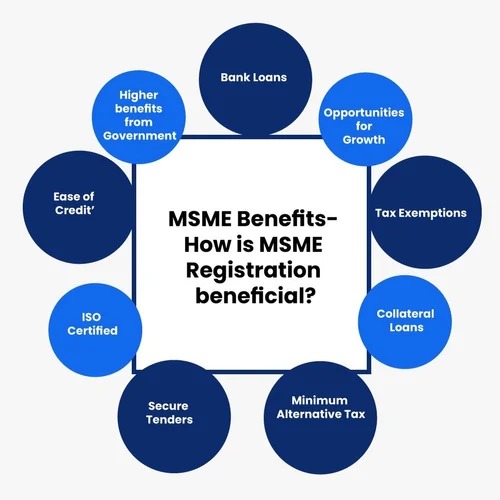
Government Benefits with MSME Registration:-
Registering your business as an MSME unlocks several government benefits aimed at supporting small businesses. Here are some of the key advantages you can enjoy:
Financial Benefits:
Subsidized Loans: MSMEs can take advantage of lower interest rates and loan subsidies available through various government programs.
Collateral-Free Financing: Through initiatives like the Credit Guarantee Fund Trust for Micro and Small Enterprises (CGTMSE), MSMEs can secure loans without needing collateral.
Reimbursement for Patent Registration: MSMEs can get financial assistance to cover the costs of registering patents, trademarks, and designs.
Tax Benefits:
Tax Rebate: MSMEs can benefit from tax rebates under the MSME Development Act and pay lower GST rates on certain goods and services.
Special Tax Benefits: MSMEs can also take advantage of special income tax relief, exemptions, and rebates available through government schemes.
Government Schemes and Subsidies:
Prime Minister’s Employment Generation Program (PMEGP): Provides funding to MSMEs to support job creation.
MUDRA Scheme: Offers loans up to ₹10 lakh to MSMEs under different categories such as Shishu, Kishore, and Tarun.
Technology Upgradation Fund: Grants financial aid to MSMEs for enhancing their technology.
Market Access:
Preference in Government Tendering Process: MSMEs are prioritized in government contracts, providing them with better access to these opportunities.
Eases entry into manufacturing sectors: Certain MSMEs are not required to obtain industrial licenses, easing their entry into the manufacturing sector.
Protection against Delayed Payments:
MSME Delayed Payment Act: This protects MSMEs from delayed payments by buyers. The law requires interest on late payments, ensuring that MSMEs get paid on time.
List of Credit Rating and Support:
Credit Guarantee Fund Trust: Government schemes help MSMEs improve their credit ratings, which makes it easier to access financial assistance.
Talent Development: The government provides training programs to help MSMEs improve their employees’ skills.
Conclusion:
Registering as an MSME in 2025 is easy and offers access to government benefits like subsidized loans, tax rebates, and collateral-free financing. MSMEs also gain opportunities for technology upgrades, skill development, and government contract preferences. This registration sets businesses up for growth and long-term success with government support.
Disclaimer: This blog provides general details about MSME registration and government benefits, but it is not intended as legal or financial advice. Businesses should consult legal, financial, or professional experts to ensure compliance with all relevant regulations and requirements.